
The Silent Signal Revolution: Why Contextual Intelligence Is the New Standard for 2026
Read Time 4 mins | Apr 20, 2026 10:45:33 AM | Written by: Marc Lamarche
For two decades, the web ran on a simple contract: publish content, get indexed, get found. SEO was the infrastructure layer of digital visibility.
That contract is being rewritten. AI browsers don’t index pages. They synthesize answers. And the sites they cite aren’t the ones with the most backlinks — they are the ones that respond.
Table of Contents
- What is contextual intelligence?
- How AI browsers changed the discovery model
- The static site problem
- What “responding” means in an AI-first web
- The Silent Signal: what reactive sites know that static ones don’t
- Why the behavioral layer becomes infrastructure
- What this means for your site in 2026
- FAQ
1. What Is Contextual Intelligence?
Contextual intelligence is the ability of a website to read the signals produced by a user’s behavior — scroll patterns, pause duration, intent signals, exit momentum — and respond in real time with relevant content, experiences, or activations.
A static site delivers the same content to every visitor regardless of what they do. A contextually intelligent site adapts to what is happening in the session, not what happened in a previous cohort.
In 2026, this distinction is no longer just a conversion optimization question. It is a visibility question.
2. How AI Browsers Changed the Discovery Model
Traditional search engines rank documents. A well-structured page with strong backlinks and relevant keywords rises in the results. The algorithm rewards content quality and authority signals.
AI-powered browsers and answer engines — Perplexity, ChatGPT Search, Google AI Overviews, Arc — operate differently. They synthesize responses from sources they consider authoritative and responsive. They are not looking for pages that describe things. They are looking for sources that answer questions clearly, specifically, and completely.
A static site that publishes good content but delivers the same experience to every visitor is less legible to these systems than a site that responds to user behavior and surfaces relevant information contextually.
→ Related: The End of SEO: Why AI Browsers Reward Interactive Brands
3. The Static Site Problem
Most websites were built to be visited. They present information. They do not respond to the signals that visitors produce while reading that information.
A visitor hesitating on a product comparison section is producing a signal — they need more information to decide. A static site ignores that signal. It continues to display the same content.
This passivity has always had a conversion cost. In 2026, it has a visibility cost as well.
AI systems that evaluate web content for citation-worthiness increasingly favor sources that demonstrate contextual relevance — the ability to surface the right information for the right query, not just the right page for the right keyword.
4. What “Responding” Means in an AI-First Web
Responding does not mean chatbots. It does not mean AI-generated copy. It means the ability to detect behavioral signals and activate relevant experiences in the current session.
A site that responds to hesitation with relevant social proof is demonstrating contextual intelligence. A site that detects exit intent and surfaces a specific answer to the objection the user was reading about is demonstrating contextual intelligence. A site that adapts its content layer based on what a user is actively doing — not what a past cohort did — is demonstrating contextual intelligence.
This is what Behavioral Commerce enables. And it is becoming the infrastructure standard for the AI-first web.
5. The Silent Signal: What Reactive Sites Know That Static Ones Don’t
Every user session produces hundreds of behavioral signals. Most websites collect none of them in real time.
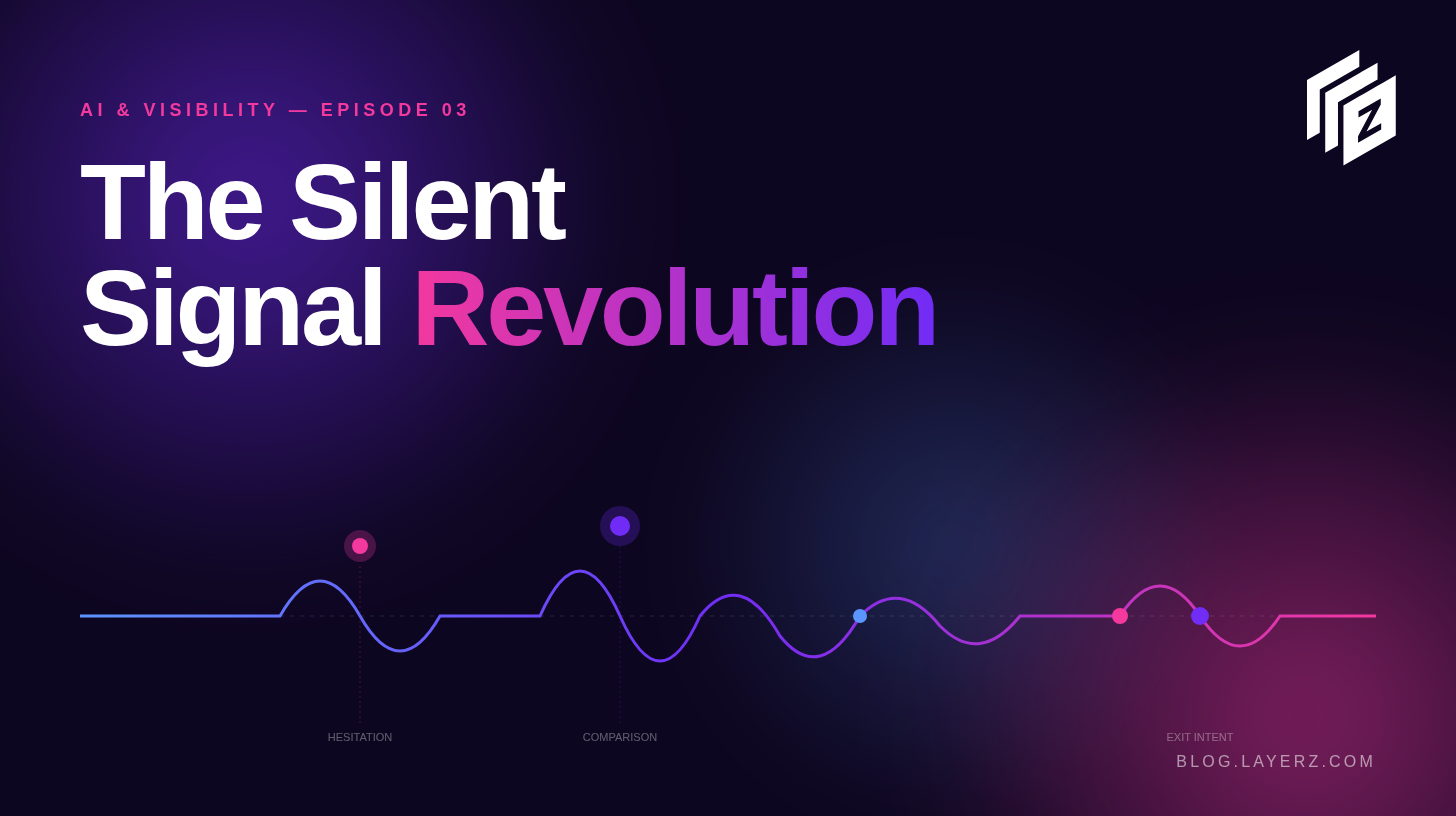
The hesitation signal. A user pausing on a specific element for more than 10 seconds is not reading passively. They are evaluating. A reactive site detects this and responds. A static site does not.
The comparison signal. A user toggling between pricing tiers is comparing. A reactive site surfaces the differentiator. A static site waits.
The exit signal. Cursor movement toward the browser chrome precedes exit by 1–3 seconds. A reactive site responds in that window. A static site registers a bounce.
These signals are not visible in historical cohort data. They are visible only in the current session. And they are the signals that AI systems increasingly use to evaluate content relevance.
6. Why the Behavioral Layer Becomes Infrastructure
SEO became infrastructure because every serious website eventually needed it. The CDP became infrastructure because every data-driven team eventually needed a unified customer profile.
The behavioral layer — the ability to detect real-time signals and activate contextual responses — is following the same trajectory.
In 2026, the question is not whether a website should respond to user behavior. The question is which layer handles that response — and how fast.
LayerZ deploys a behavioral layer on top of any existing website without code modifications. It detects signals at the session level and activates experiences in under 200ms. It is the infrastructure layer for the reactive web.
→ Related: Behavioral Commerce vs CRO: What’s the Difference?
7. What This Means for Your Site in 2026
The sites that will win in an AI-first discovery environment are not necessarily the ones with the most content. They are the ones that demonstrate the highest contextual relevance — the ability to match the right information to the right user signal, in the right moment.
For CMOs and digital leads: your SEO investment is not wasted, but it is no longer sufficient. Visibility increasingly requires behavioral responsiveness, not just content depth.
For CRO and growth teams: the conversion argument for real-time behavioral activation is already established. In 2026, the visibility argument reinforces it.
For product and development teams: the behavioral layer is not a marketing plugin. It is infrastructure. Build for it accordingly.
FAQ
Does this mean SEO is dead?
No. Structured content, technical SEO, and authority signals still matter. But they are necessary, not sufficient. Contextual responsiveness is becoming the differentiating layer.
How does a behavioral layer affect AI citation?
AI systems increasingly evaluate sources on specificity and contextual relevance. A site that surfaces the right answer at the right moment — because it reads behavioral signals — demonstrates higher contextual intelligence than one that publishes the same content to every visitor.
Does implementing a behavioral layer require a site rebuild?
No. LayerZ deploys via a script tag on any existing website without code modifications. Time to deployment: days.
What signals should I prioritize first?
Start with exit intent on your top three conversion pages. Add hesitation detection on pricing and product comparison sections. These are your highest-leverage signal categories.
→ What is Behavioral Commerce? layerz.com/behavioral-commerce
→ Book a Demo: layerz.com/book-demo