
Summary: The digital growth playbook is being rewritten. Organizations across all sectors are hitting an "Optimization Wall"—a plateau where traditional Conversion Rate Optimization (CRO) efforts yield diminishing returns. As user behavior becomes more fragmented and privacy regulations tighten, the "static web" is failing to convert. This white paper explores the rise of the Revenue Efficiency Layer: a new category of technology that delivers real-time, intent-based experiences without the need for heavy development or invasive tracking.
The Optimization Wall: Why Growth Stalls
Most digital platforms suffer from a common paradox. Despite sophisticated analytics and constant design updates, bounce rates remain stubbornly high, and engagement on key "money pages" eventually flattens.
The culprit isn't usually the design; it's the latency of relevance. Traditional websites are built as "one-size-fits-all" structures. When a user arrives, the site "guesses" what they want based on broad demographics or past cookies. If that guess is wrong, the user bounces. To fix this, companies typically turn to heavy personalization projects that require months of engineering time and complex data integrations. By the time the solution is deployed, the market—and the user’s intent—has shifted.
From Marketing Tool to Revenue Efficiency
The industry is currently witnessing a pivot in how digital performance is managed. Forward-thinking executives are moving away from seeing conversion as a "marketing task" and instead viewing it through the lens of Revenue Efficiency. This involves an intelligent layer that sits atop existing infrastructure, solving the three most common bottlenecks in the modern revenue pipeline:
1. Real-Time Adaptation vs. Static Guessing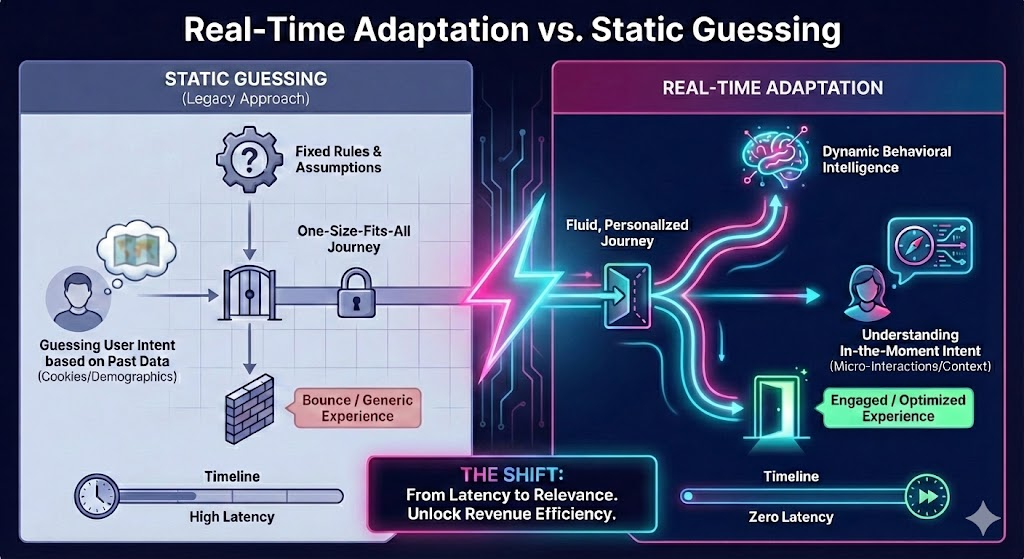
Instead of waiting for a user to complete a journey (or drop off) to analyze their behavior, modern systems adapt the experience in real-time.
By utilizing Dynamic Behavioral Intelligence, these platforms identify "micro-intentions"—the subtle ways a user interacts with a page—and adjust the content immediately. It turns a static brochure into a living, responsive dialogue.
2. Micro-Interactions vs. Heavy Dev Work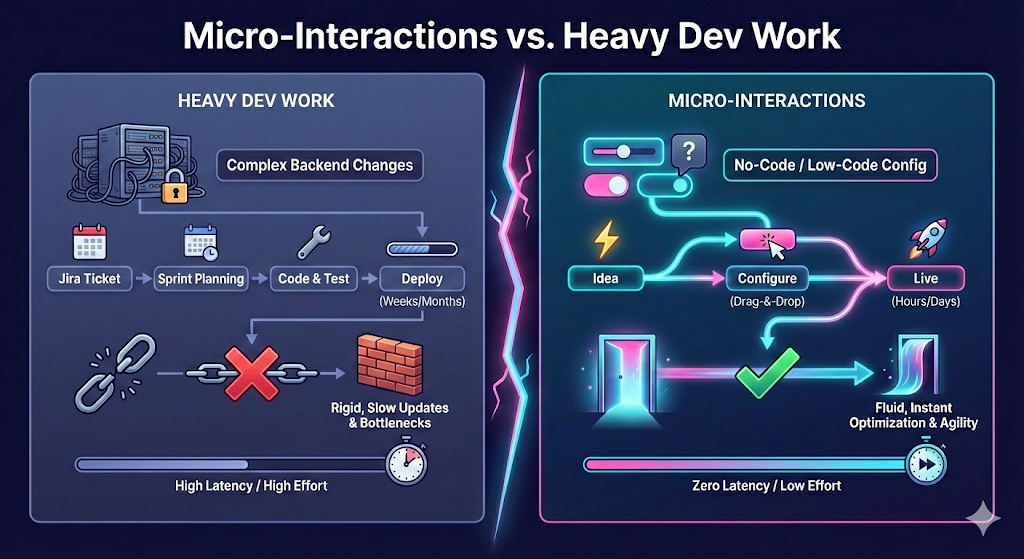
One of the primary reasons optimization plateaus is the "Engineering Bottleneck." Marketing teams often have ideas for better user journeys but lack the developer resources to build them. Revenue efficiency layers enable No-code experimentation.
Through micro-interactions—small, interactive touchpoints that guide users toward their goals—teams can test and deploy new pathways in hours rather than months, without rebuilding the core site.
3. Privacy-First Intent vs. Cookie Reliance
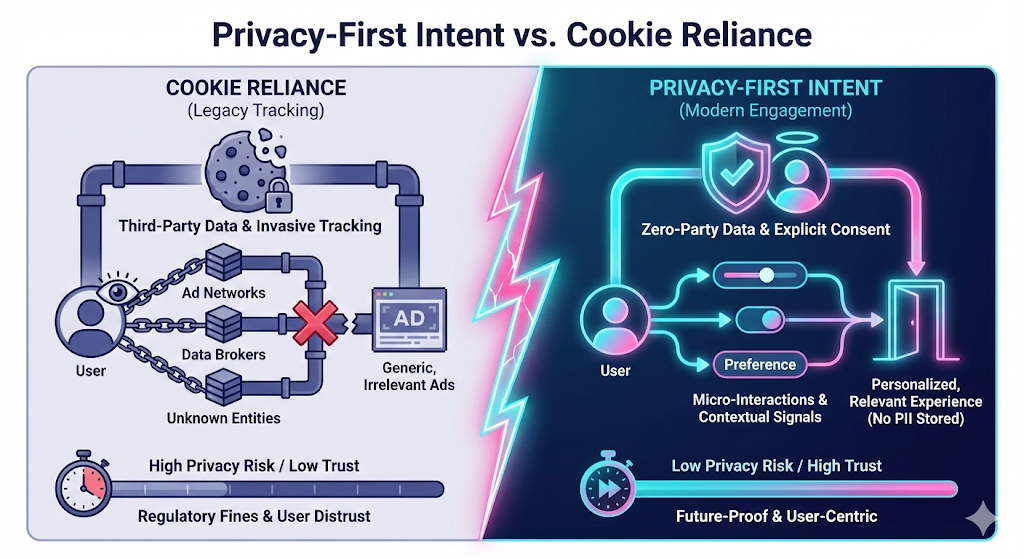
As the "cookie-less future" becomes a reality, traditional tracking is failing. High-efficiency layers bypass this by focusing on in-the-moment behavior rather than historical tracking. By understanding what a user is doing now, the platform can guide them effectively without needing to store invasive personal data. This isn't just a compliance win; it’s a trust-builder with a Gen Z and Alpha audience that is increasingly "gate-averse."
The "Nudge" Economy: Guiding the Journey
The most significant impact of a Revenue Efficiency Layer is the reduction of friction. Traditional UX often forces users through "gates"—long forms or rigid navigation. Modern approaches replace these gates with contextual nudges.
If a user lingers on a specific technical specification, the system doesn't wait for them to find a "Contact Us" page. It might subtly highlight a relevant case study or offer a real-time eligibility check based on their current browsing patterns. It’s the difference between a shopkeeper waiting behind a counter and a concierge who anticipates your needs as you walk through the aisles.
The Business Outcome: ROI through Efficiency
When organizations deploy a dedicated efficiency layer, the primary metric isn't just "Conversion Rate"—it’s Revenue per Visitor (RPV). By identifying and capturing the "invisible" 90% of traffic that usually bounces, companies are finding that they don't necessarily need more traffic; they need their current traffic to be more efficient. This shift reduces Customer Acquisition Costs (CAC) and ensures that every marketing dollar spent actually has a direct, measurable path to conversion.
Conclusion: What Next?
The digital landscape is moving from an era of "Big Data" to an era of "Big Intent." Organizations that continue to rely on static pages and invasive tracking will find their growth curves flatlining.
The next step for digital leaders is to evaluate their "Revenue Efficiency." Are your current systems guiding users, or are they just standing in their way? By implementing an interoperable intent layer, brands can finally break through the optimization plateau and turn their digital presence into a self-optimizing revenue engine.
The question is no longer "How do we get them to our site?" but "How do we adapt the site to them the moment they arrive?"