
Behavioral Commerce vs CRO: What's the Difference?
Read Time 5 mins | Apr 7, 2026 8:59:31 PM | Written by: Marc Lamarche
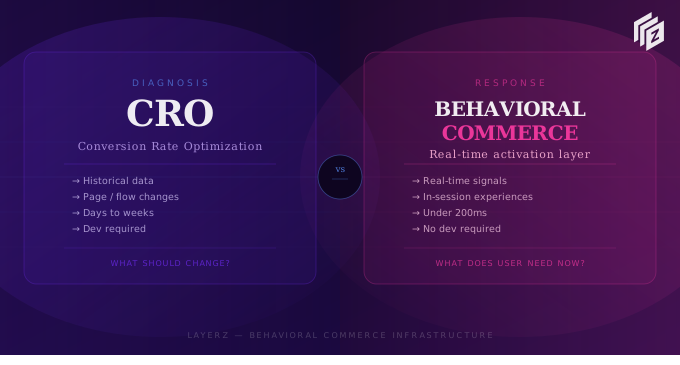
Behavioral Commerce and Conversion Rate Optimization (CRO) are complementary disciplines that address the same problem — converting more website visitors into customers — but from fundamentally different angles. CRO identifies what needs to change through testing and analysis. Behavioral Commerce acts on what users are doing right now, without waiting for a test cycle to complete.
Understanding the difference is critical for any growth or e-commerce team that has hit the optimization plateau.
Table of Contents
- What is CRO?
- What is Behavioral Commerce?
- The core difference: diagnosis vs. response
- Where CRO stops working
- What Behavioral Commerce adds
- Why they're complementary, not competing
- Which one do you need?
- FAQ
1. What is CRO?
Conversion Rate Optimization (CRO) is the practice of improving the percentage of website visitors who complete a desired action — a purchase, a sign-up, a demo request — through systematic testing and analysis.
A typical CRO workflow looks like this: identify a friction point via heatmaps or analytics, form a hypothesis, design a variant, run an A/B test, analyze results, and ship the winning version. The cycle takes days to weeks. The output is a permanent change to the page or flow.
CRO is inherently retrospective. It uses data from past behavior to design better future experiences. It is a design and development discipline as much as a marketing one.
2. What is Behavioral Commerce?
Behavioral Commerce is a website infrastructure approach that detects real-time user behavior — hesitation, scroll patterns, bounce intent — and automatically triggers personalized experiences in the moment, without modifying the underlying site.
Where CRO asks “what should this page look like for most users?”, Behavioral Commerce asks “what does this user need right now?”
The two questions are not the same. And most teams are only answering the first one.
→ Internal link: layerz.com/behavioral-commerce
3. The Core Difference: Diagnosis vs. Response
The clearest way to understand the difference is through a medical analogy.
CRO is the annual check-up. It analyzes patterns, identifies systemic issues, and recommends structural changes. Essential. But scheduled.
Behavioral Commerce is the ER. It detects a signal in real time and responds immediately. It doesn’t wait for the next test cycle. It acts while the patient — your visitor — is still in the room.
| CRO | Behavioral Commerce | |
|---|---|---|
| Operates on | Historical data | Real-time signals |
| Output | Page/flow changes | In-session experiences |
| Speed | Days to weeks | Under 200ms |
| Dev required | Yes | No |
| Scope | Site-wide improvements | Individual session responses |
| Question answered | What should change? | What does this user need now? |
4. Where CRO Stops Working
CRO has been the dominant conversion discipline for 15 years. It works. But it has structural limits that become painfully visible at scale.
The averaging problem. A/B tests optimize for the average user. They produce pages that perform marginally better for the majority — but they do nothing for the 30% of visitors who hesitate, the 15% who scroll back to the same section twice, or the 5% who are one contextual nudge away from converting.
The latency problem. By the time a CRO cycle completes — hypothesis, test, significance, ship — the behavioral moment has long passed. Intent fades in seconds. CRO operates in weeks.
The dev dependency problem. Every CRO recommendation eventually requires a developer. Design changes, flow modifications, copy updates — all go into a sprint queue. The insight and the action are structurally separated.
According to industry benchmarks, average e-commerce conversion rates have remained flat at 1–3% for nearly a decade despite massive CRO investment. The discipline is mature. The plateau is real.
5. What Behavioral Commerce Adds
Behavioral Commerce doesn’t replace CRO. It activates in the gaps CRO can’t reach.
The hesitation gap. A user pausing on your pricing page for 45 seconds isn’t a data point for your next A/B test. It’s a live signal. Behavioral Commerce detects it and responds — a social proof overlay, a comparison nudge, a “talk to someone” micro-CTA — while the user is still deciding.
The scroll loop gap. A user who returns to the same product section three times isn’t confused about your UX. They’re hesitating on a specific element. CRO will eventually redesign that section. Behavioral Commerce surfaces the answer now.
The exit intent gap. A user moving toward the back button isn’t just a bounce statistic. It’s a recoverable moment — if you respond within 1–2 seconds with something specific to what they were doing.
6. Why They’re Complementary, Not Competing
The best-performing digital teams use both — in sequence.
CRO tells you where the structural problems are. Behavioral Commerce handles the moments CRO can’t reach in time.
CRO improves the baseline. It makes your pages better for the average visitor. It reduces systemic friction. It should keep running.
Behavioral Commerce lifts the ceiling. It recovers the visitors that even a well-optimized page loses — the hesitators, the comparison shoppers, the almost-converted.
Optimized page (CRO)
    +
Real-time behavioral activation (Behavioral Commerce)
    =
Maximum conversion recovery
7. Which One Do You Need?
You need CRO if:
- Your pages have obvious structural UX problems
- You haven’t systematically tested your core flows
- Your conversion rate is below industry benchmarks
You need Behavioral Commerce if:
- Your pages are well-optimized but conversion has plateaued
- You have significant traffic but can’t identify why users leave
- Your dev team is a bottleneck for implementing insights
- You want to recover high-intent visitors in real time
You need both if:
- You’re serious about closing the gap between traffic and revenue
FAQ
Does Behavioral Commerce replace A/B testing?
No. A/B testing remains essential for identifying structural improvements. Behavioral Commerce operates on top of those improvements — activating real-time responses to individual session signals that A/B tests can’t address.
Can I run CRO and Behavioral Commerce simultaneously?
Yes, and it’s recommended. They operate at different speeds and on different inputs. No conflict.
Does Behavioral Commerce require a CRO foundation to work?
No. It deploys via a script tag on any website regardless of CRO maturity. A well-optimized page combined with behavioral activation produces better results than either alone.
How do I measure the impact of Behavioral Commerce separately from CRO?
Behavioral Commerce platforms track activation events independently from your A/B testing stack. The two measurement frameworks don’t overlap.
What’s the fastest way to get started with Behavioral Commerce?
Map your top 3 exit pages. For each one, identify the behavioral pattern that precedes exit. That’s your signal inventory. Deployment takes days, not sprints.
Version 1.0 — Published April 2026
→ What is Behavioral Commerce? Full guide: layerz.com/behavioral-commerce
→ When Optimization Hits the Technical Wall: blog.layerz.com/when-optimization-hits-the-technical-wall